

Breast fat transfer scars are typically small and inconspicuous because the procedure relies on liposuction rather than breast implant incisions. As a board-certified, Stanford-trained plastic surgeon with more than 20 years of experience, I’ve refined my approach to natural breast augmentation with fat transfer to help women achieve modest fullness with minimal scarring and a faster recovery.
Let’s take a closer look at how the smaller incisions used in breast fat transfer typically heal and fade after your procedure.
Does Breast Fat Transfer Leave Scars?
Yes, but only at the donor sites; not on the breast itself. The fat is harvested through tiny liposuction entry points, which are generally small scars, while the fat is then injected into the breast through pinpricks so minimal they aren’t really considered scars at all. I often use the SVELT (small-volume elective liposuction transfer) technique for fat transfer breast augmentation, an in-office procedure involving a series of smaller grafts performed under local anesthesia.
In addition to being an efficient approach, it supports better fat cell survival, faster recovery, and subtle, gradual enhancement achieved over multiple sessions. However, it’s important to recognize that natural breast augmentation with fat transfer is best suited for women seeking a modest increase (typically about 1 cup size). Women who prefer a dramatic change are typically better candidates for traditional breast augmentation.
What Do Breast Fat Transfer Scars Look Like?
The donor-site scars are tiny because I make very small liposuction entry points, and I place them in natural creases and areas where they won’t be noticeable. On the breast side, the injection points are even less noticeable, more aptly describes as pinpricks versus scars. This approach reduces scarring compared to breast augmentation with implants, and any minimized scars from the liposuction areas tend to fade significantly over time.
What Are the Different Types of Breast Augmentation Scars?
There are two main types of breast augmentation scars: liposuction entry points from fat transfer, and breast incisions from implant surgery. Understanding the types of breast augmentation scars can help you decide which approach fits your goals.
- Fat transfer involves no incision on the breast at all—only the liposuction entry points at the harvest sites.
- Traditional breast implants, by comparison, do require a breast incision, placed at one of 3 possible locations:
- Inframammary (in the natural crease under the breast)
- Periareolar (around the lower border of the areola, where the scar can blend in once healed)
- Transaxillary (in the armpit)
I also use the Keller Funnel® technique to place silicone implants through a smaller incision than would otherwise be needed. Regardless of which approach we decide to take, my aim is always to help you achieve natural-looking results that complement your body frame, goals, and lifestyle.
How Do Breast Fat Transfer Scars Heal?
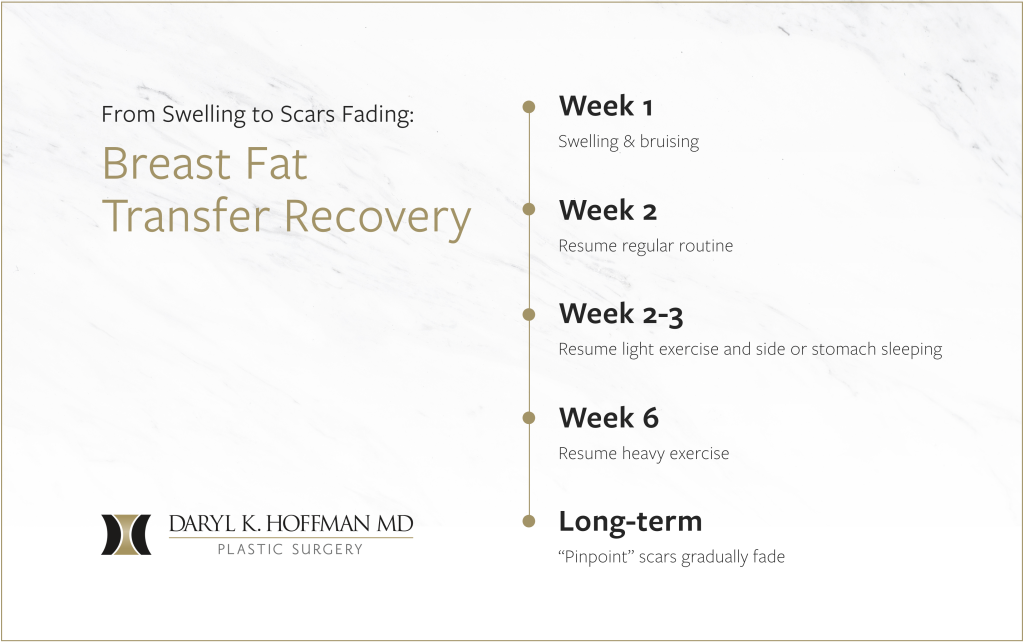
Breast fat transfer scars heal in stages, starting with initial swelling and bruising that compression bandages help manage in the days right after your procedure. Any discomfort during the early period can typically be managed with over-the-counter or prescription medications. You can resume light activity within a couple of weeks, though I recommend waiting for strenuous exercise until you’re cleared, typically around 6 weeks post-op.
What Do Healed Breast Augmentation Scars Look Like?
Once healed, fat transfer entry points are among the least noticeable scars in breast augmentation, since there’s no incision on the breast itself. Many patients appreciate not needing to plan around breast-area scarring during recovery. For related recovery tips, this guide on sleeping after breast augmentation may help.
Ready To Explore Your Breast Enhancement Options?
If you’d like a closer look at whether fat transfer or implants fit your goals, request a consultation with me in Palo Alto or Campbell, CA. To get started, complete the online form or call us at (650) 325-1118.
Leave a Reply