
Fat transfer breast augmentation is an attractive option for women who want a modest increase in the size of their breasts without implants. Before getting a “natural boob job,” however, you should understand how long the results last compared to augmentation with breast implants.
The good news is that fat grafting can deliver long-lasting, natural-looking results. But as with any aesthetic procedure, there are important factors that influence how your outcome evolves in the months and years ahead.
Understanding How Fat Transfer Works
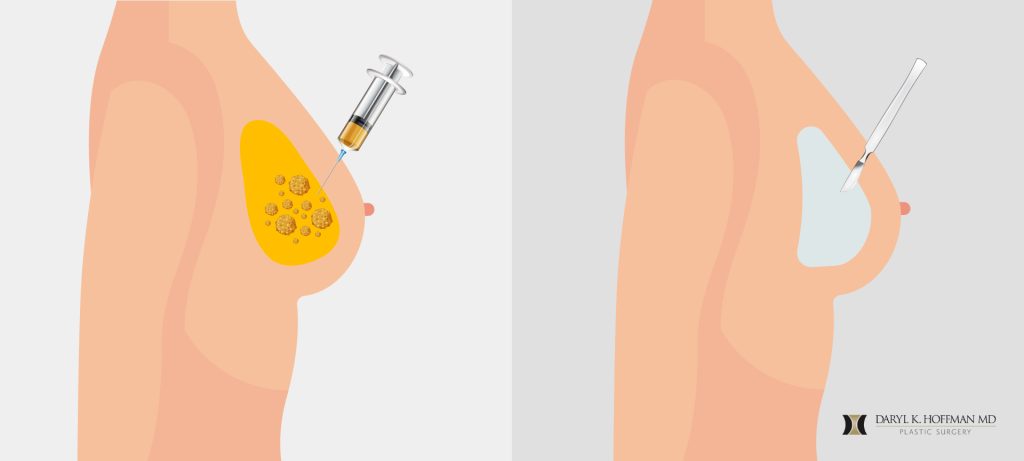
Fat transfer breast augmentation uses your body’s own fat to enhance breast shape and volume. During a traditional fat grafting procedure, a surgeon harvests fat from areas such as the abdomen or thighs using liposuction. The fatty tissue is then spun in a centrifuge to remove impurities. The purified fat is then injected into the breasts to create a subtle, natural-looking enhancement.
Fat Transfer Using the SVELTE Technique
In addition to traditional fat transfer breast augmentation, I perform small-volume elective liposuction transfer (SVELTE) procedures for women who want to gradually increase the size of their breast through a series of appointments.
This is an in-office procedure that involves a series of smaller grafts performed under local anesthesia, making it both efficient and more comfortable. Fat transfer breast augmentation is best suited if you’re seeking a modest increase—typically about one cup size—and a natural feel. If your goals evolve over time, we can build on your initial results.
What Happens After Fat Transfer?
Immediately after your procedure, your breasts will look fuller than your final result, which is intentional. Because not all fat cells will survive the procedure, you can expect a small decrease in volume over the first few weeks. I plan for that expected loss during your procedure by slightly overfilling the area. Over the next 3 to 6 months, your results gradually stabilize as swelling resolves and the surviving fat cells settle into place.
One of the advantages of the SVELTE procedure is more cells typically survive the transfer process. Up to 70% of the grafted fat cells establish a blood supply in their new location and become part of your body.
Are the Results Permanent?
The fat cells that successfully survive the transfer are considered permanent. Once they integrate into the breast tissue, they behave just like the rest of your natural fat. That means your results can last for many years—often indefinitely—without the need for replacement, unlike breast implants.
However, permanent doesn’t mean unchanged. Your breasts will continue to respond to your body over time.
What Can Affect the Longevity of Results?
Several factors influence how your results hold up over the long term:
Weight fluctuations
Because the transferred fat is living tissue, it will respond to weight changes. If you gain weight, your breasts may become slightly fuller. If you lose weight, you may notice some volume loss. Maintaining a stable weight is one of the most important factors in preserving your results.
Aging and skin elasticity
Just like natural breast tissue, fat transfer results are subject to aging. Over time, skin laxity can develop, and the breasts may gradually change shape or position.
Fat survival rate
Every patient’s body is different. While most patients retain a significant portion of the transferred fat, the exact percentage varies. A skilled surgical technique plays a major role in maximizing fat survival.
Lifestyle and overall health
Healthy circulation, good nutrition, and avoiding smoking all support better fat graft survival and longer-lasting results.
Fat Grafting or Implants
How Fat Transfer Compares to Implants
One of the biggest advantages of fat transfer is that your results don’t require maintenance. Breast implants typically need to be replaced at some point, while fat transfer results, once established, do not require routine replacement.
That said, fat transfer produces more subtle enhancement and depends on your body’s biology. The results are less predictable than choosing a specific implant size. It’s not a one-size-fits-all solution, which is why patient selection and expectations are so important. There are pros and cons involved in both fat transfer and implant-based augmentation.
Request a Consultation
The best way to decide between fat transfer and implants is to meet with a trusted board-certified plastic surgeon. During your consultation, we’ll assess your body, discuss your goals, and design a personalized treatment plan to help you achieve your ideal results. If you’d like to learn more about your options, please call our office at (650) 325-1118 (Palo Alto) or (408) 371-1118 (Campbell). Or, request a consultation online to get started.
Leave a Reply